Continuing the Legacy
March 17, 2106
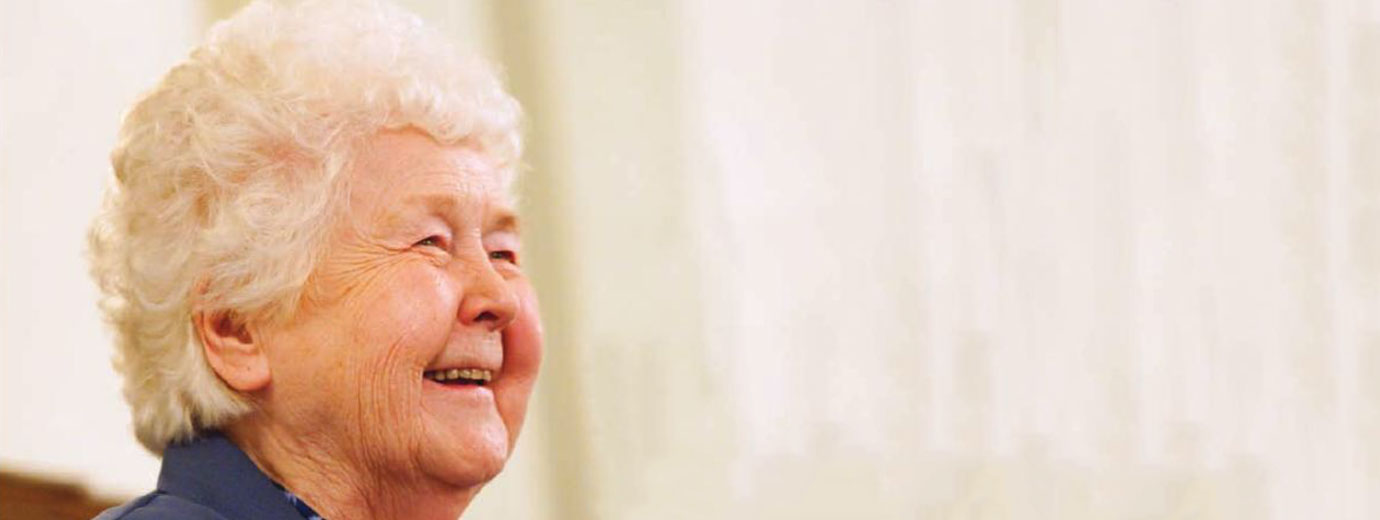
What began as a request for Sister Gemma Del Duca to plan a Shabbat dinner for the Sisters of Charity who gathered at Seton Hill University for their annual assembly in 1987 led to the creation of an important international education center, the University’s National Catholic Center for Holocaust Education (NCCHE), the only one of its kind in the United States at the time.
At that dinner were Sister Mary Noël Kernan, who in January 1987 had made her first trip to Jerusalem to visit Sister Gemma, who had been living and working there for a dozen years; JoAnne Boyle, who would become president of Seton Hill that year; and Jewish faculty member Sybil Schwartz, now a member of NCCHE’s Advisory Board.
And as a result of that dinner — and against the backdrop of Pope John Paul’s II historic visit to a synagogue the year before and his encouragement to promote religious studies for the Holocaust, an event that “concerns the whole of humanity” — came discussions about Seton Hill implementing an institute in Israel where Catholics could study the Holocaust. When Sister Gemma presented a proposal for the institute to Boyle on her first day as president, she agreed to take it to the board of trustees, who unanimously approved it.
Bashert?
Bashert is a Yiddish word suggesting that the seemingly random events of our lives are, in fact, a clear, comprehensible narrative when considered from a divine perspective.
“The Center wasn’t something I expected in my life,” said Sister Noël, who with Sister Gemma served as the Center’s founding co-directors. “I think of it as a gift from God.”
Sister Noël, who retired as co-director in 1997, and Sister Gemma, who stepped down last year, were honored at the NCCHE’s first “Continuing the Legacy” dinner at the Twentieth Century Club in Pittsburgh on April 29. They continue to work with the Center, respectively, as coeditor of the newsletter and as onsite consultant for its program with the Yad Vashem International School for the Holocaust, an educational and research center established in Israel shortly after World War II.
“The Center seemed to have started on a wing and prayer,” said Tim Crain, who became the director in 2014. “The approach with this Catholic center, which would have a revolutionary effect, quite frankly, was bridge building and a new beginning. This is what the Sisters saw, to move the relationship between Catholics and Jews forward.” Through the years, the Center’s work has been demonstrated in many ways, but at its core has been the mission of educating educators about the Holocaust. Since the first three-week Summer Institute was held two years after the Shabbat dinner, in 1989, more than 220 educators from across the United States and Canada have traveled to Israel to attend. They have included higher education faculty and administrators, middle and high school teachers, and priests and seminarians. Among them were approximately 120 Seton Hill faculty and administrators.
One of them was Seton Hill studio arts professor Carol Brode, who in 2009 participated in the Summer Institute, which includes full days of classroom instruction and numerous field trips with counterparts from Yad Vashem to historic Jewish and Christian sites.
“It was an incredibly invaluable experience,” said Brode. “The quality of the scholars during the classroom sessions was very high, and I learned so much about Jewish history, not only about the Holocaust but the centuries leading up to it. Being immersed in the Jewish culture really opened my eyes to worlds I wasn’t aware of.”
Honoring the Founders
Seton Hill University’s commitment to the Holocaust Center was evident at the April event honoring the founders, which President Mary Finger invited to be a part of Inaugural Week Activities.
“Sister Gemma and Sister Noël have become symbols of the effort to help others, and in a special way Catholics, to recognize the unique character of the Holocaust and how it helps define Catholic Jewish relations,” Finger said during the event. “Our recognition of their work comes at a time when our world faces tremendous discord. The terror in Darfur, unrest in Syria, and fear in France, underscores the significant need for the kind of work Seton Hill’s National Catholic Center for Holocaust Education supports.” Tributes were offered during the event from friends of the Center, who all praised the work of Sister Gemma and Sister Mary Noël.
“Yes, they had help and support from others, but Sisters Gemma and Noel conceived this center, created it, nourished it, guided it, invested it with their energy, their imagination, their integrity,” said Judith Banki, senior advisor for Interreligious Affairs at the Tanenbaum Center for Interreligious Understanding. “I am aware that the initials of their order stand for Sisters of Charity. To me, those initials also spell out Sisters of Compassion and Sisters of Commitment.”
Sister gemma and Sister noël have become symbols of the effort to help others, and in a special way Catholics, to recognize the unique character of the Holocaust and how it helps define Catholic Jewish relations.
Seton Hill President Mary C. Finger
Proceeds from the event supported the Dr. Eva Fleischner Endowed Fund for Visiting Scholars and Students in Holocaust and Genocide Studies at the National Catholic Center for Holocaust Education, which was established by Pittsburgh residents Hans and Leslie Fleischner in honor of his sister.
Dr. Eva Fleischner is a Catholic theologian, gifted author and professor who has taught, lectured, and written extensively on Holocaust. She has also been deeply committed to Jewish-Christian dialogue. The Fleischner Fund will help Seton Hill expand Holocaust studies on the Greensburg campus.
The University’s Genocide and Holocaust Studies program also works to educate teachers about the event. Developed in association with NCCHE, the online graduate certificate program assists current and future educators, historians, and scholars in understanding the cultural, political, economic, and religious forces behind genocide.

According to Crain, who had extensive experience in Holocaust education and outreach in Wisconsin prior to his appointment at Seton Hill, the Commonwealth of Pennsylvania last year approved a recommendation that “strongly encouraged the teaching of the Holocaust in high schools and middle schools.” Seton Hill’s certificate program will be valuable in helping to educate the Commonwealth’s teachers about the Holocaust, said Crain.
Also part of the Center’s work is the Ethel LeFrak Holocaust Education Conference held triennially at Seton Hill.
“Scholars from around the world come to campus to present papers that help shape the curriculum at Catholic and other educational institutions,” said Crain.
Keynote speaker for the 2015 conference will be the Rev. Patrick Desbois, the renowned Roman Catholic priest who since 2001 has crisscrossed Ukraine in an effort to locate the sites where Jews were systematically killed and buried during World War II. This year’s conference is titled “The Holocaust and Nostre Aetate : Towards a greater understanding,” in recognition of the 50th anniversary of the signing of “In Our Time,” the first Vatican II proclamation to address the Catholic Church’s relationship with non-Christian religions.
Crain hopes to extend the Center’s outreach through the LeFrak Conference, his own speaking engagements and other efforts.
“The Center is very prominent in the Northeast and among those who know the Holocaust well, but what I’d like to do is expand its visibility and what we do to a national level,” he said.
It was the discussions among several individuals at a Shabbat dinner almost 30 years ago that helped launch the Center, and the dialogue that continued through the decades has advanced its mission, said Sister Gemma.
“Because of the dialogue, I think we’ve helped faculty and students cross borders, religious borders and international borders, and to meet people they never would have met without the Center,” she said.
Bashert!
Make a gift in support of National Catholic Center for Holocaust Education.